AI Writing Detectors and the Non-Native English Speaker Problem
Schools adopting AI writing detectors are making a quiet but consequential bet: that these tools can tell the difference between a student’s own writing and AI-generated text accurately enough to base an academic integrity conversation on. The best available research on that bet is more unsettled than the marketing suggests.
What the original research found
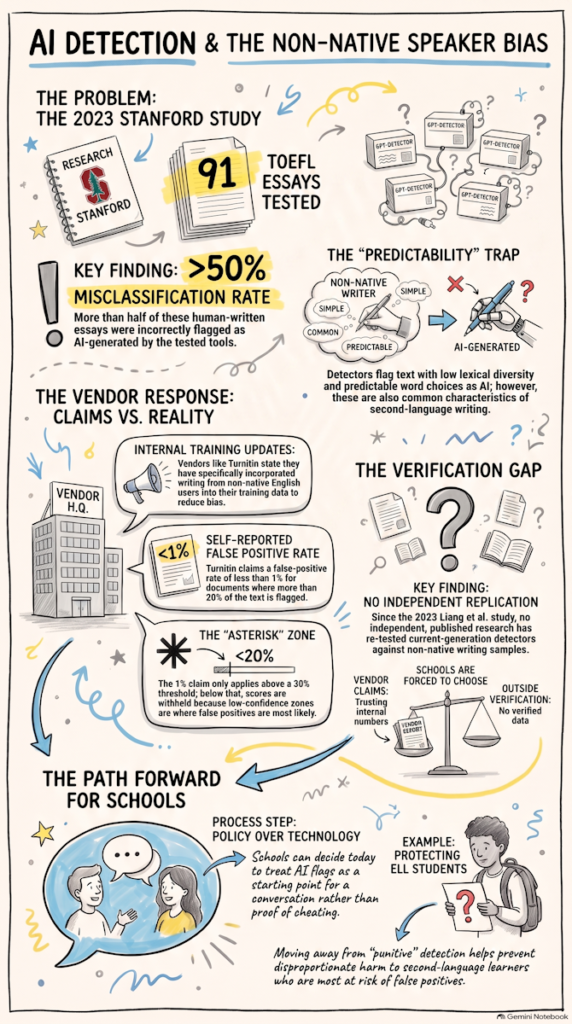
In 2023, a Stanford team (Liang, Yuksekgonul, Mao, Wu, and Zou) published a study in Patterns testing seven widely used GPT-detection tools against 91 real TOEFL essays — human-written essays by non-native English speakers, none of them AI-generated. More than half were misclassified as AI-generated. The likely mechanism: these detectors flag text with lower lexical diversity and more predictable word choices as “AI-like,” and non-native writers, as a group, tend to write with exactly those features — not because they used AI, but because that’s a known characteristic of second-language writing.
This wasn’t a study of one bad tool. It was seven separate detectors, all showing the same pattern — evidence of a structural bias in how this generation of detectors worked, not a one-off bug.
What’s changed since
Vendors have responded. Turnitin’s current public documentation states it deliberately incorporated “second-language learners” and “English users from non-English speaking countries” into its training data specifically to reduce this kind of bias, and it publishes a less than 1% false-positive rate for documents where over 20% is flagged as AI-generated — validated, per their documentation, against 700,000 academic papers written before ChatGPT existed.
Two details in that claim matter for how much weight to put on it. First, it’s a self-reported figure from internal testing, not an independent replication of the specific bias question Liang et al. raised — nobody outside the vendor has re-run the non-native-speaker-essay test against the current model and published the result. Second, the 1% figure applies only above the 20% AI-detected threshold; below that, Turnitin’s own system deliberately withholds a specific percentage (showing an asterisk instead) precisely because low-confidence scores are where false positives are most likely — which is a reasonable design choice, but it also means the headline number doesn’t cover the exact zone where the original bias problem would show up most.
Why this matters more than a technical footnote
A false positive here isn’t a minor inconvenience — it’s a student, disproportionately likely to be a second-language learner, being told their own work looks like cheating. For a school or district evaluating whether to enable an AI-detection feature, “the vendor says they fixed it” and “an independent study confirmed it’s fixed” are different levels of assurance, and only the first one currently exists for this specific question.
The open problem: no independent, published study has re-tested current-generation detectors against non-native English writing samples the way Liang et al. did in 2023. Until one does, schools are choosing between trusting vendor-reported numbers or not using these tools at all — there’s no third option grounded in outside verification. A practical middle path — treating any AI-detection flag as a conversation starter rather than evidence, especially for ELL students — is a policy decision schools can make today without waiting on research that doesn’t exist yet.
Sources:
- Liang, W., Yuksekgonul, M., Mao, Y., Wu, E., & Zou, J. (2023). GPT detectors are biased against non-native English writers. Patterns, 4(7).
- Turnitin. AI writing detection capabilities FAQs (accuracy, methodology, and bias-mitigation claims).