
How AI Tutors Are Changing Homework Help
Over the past two years, AI-powered tutoring tools have moved from novelty to a genuine part of many students’ homework routines. Instead of waiting for a scheduled session, a student can now ask a chatbot to walk through a tricky problem at 9pm on a Tuesday. The pitch is obvious. Whether it delivers depends entirely on how the tool is built.
The old problem this is trying to solve
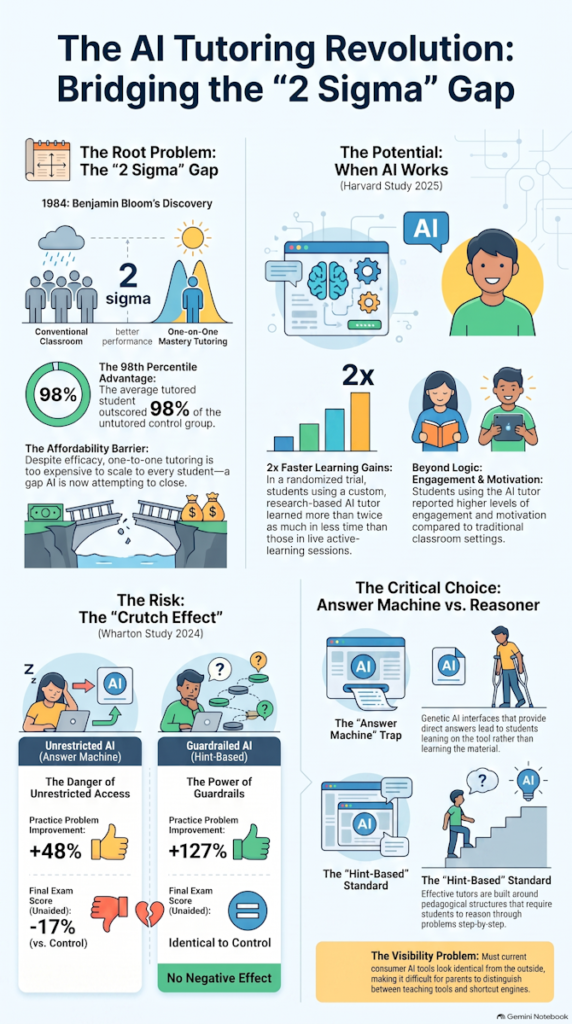
The reason AI tutoring gets so much attention isn’t hype — it’s chasing a 40-year-old finding. In 1984, Benjamin Bloom published research showing that students who received one-on-one mastery tutoring performed two standard deviations better than students in a conventional classroom — the average tutored student outscored 98% of the untutored control group. Bloom called this the “2 sigma problem”: one-to-one tutoring clearly works, but it’s too expensive to give every student a personal tutor. AI-powered tutoring is, essentially, an attempt to close that affordability gap at scale.
The evidence it can actually work
A 2025 randomized controlled trial from Harvard (Kestin, Miller et al., published in Scientific Reports) tested this directly. In a physics course, 194 students were split between a live, in-class active-learning session and a custom AI tutor built on the same research-based pedagogy. Students using the AI tutor learned more than twice as much in less time than the in-class group — and reported higher engagement and motivation. This is one of the more convincing pieces of evidence that a well-designed AI tutor can approximate real tutoring gains, not just a chat-based FAQ.
The evidence it can also backfire
But “AI tutor” isn’t one thing, and design changes the outcome entirely. A 2024 field experiment (Bastani et al., Wharton, published in PNAS) put nearly 1,000 Turkish high school students through three conditions: no AI, unrestricted GPT-4, and a guardrailed GPT-4 tutor that gave hints instead of direct answers.
- Students with unrestricted access improved 48% on practice problems — then scored 17% worse than the control group on a later exam without AI. They’d learned to lean on the tool, not the material.
- Students using the hint-only version improved 127% on practice, and their unaided exam scores were statistically identical to the control group. Same practice gains, no crutch effect.
What actually separates the two outcomes
Both studies used a capable AI model. The difference wasn’t the underlying technology — it was whether the tool was built to hand over answers or to require the student to reason through the problem. The Harvard tutor was built around a specific pedagogical structure; the “unrestricted” arm of the Bastani study behaved like a generic answer machine.
That’s the practical problem for anyone choosing a homework-help tool right now: most consumer AI products don’t advertise which one they are, and a chat interface looks the same either way from the outside. A checklist for telling a “hint-based tutor” from an “answer machine” before handing it to a class — something a parent or teacher could actually use in five minutes — doesn’t really exist yet. That’s worth building.
Sources:
- Bloom, B. S. (1984). The 2 Sigma Problem: The Search for Methods of Group Instruction as Effective as One-to-One Tutoring. Educational Researcher.
- Kestin, G., Miller, K., et al. (2025). AI tutoring outperforms in-class active learning. Scientific Reports.
- Bastani, H., Bastani, O., Sungu, A., Ge, H., Kabakcı, Ö., & Mariman, R. (2024). Generative AI without guardrails can harm learning: Evidence from high school mathematics. PNAS.