
Designing Lessons That Use AI Without Leaning on It
One of the trickiest parts of bringing AI tools into a classroom is making sure students still do the thinking. The good news is this isn’t a new problem invented by chatbots — cognitive psychology has been studying versions of it for decades, and the findings point toward specific, checkable design choices rather than vague policy.
Sequencing matters more than the tool itself
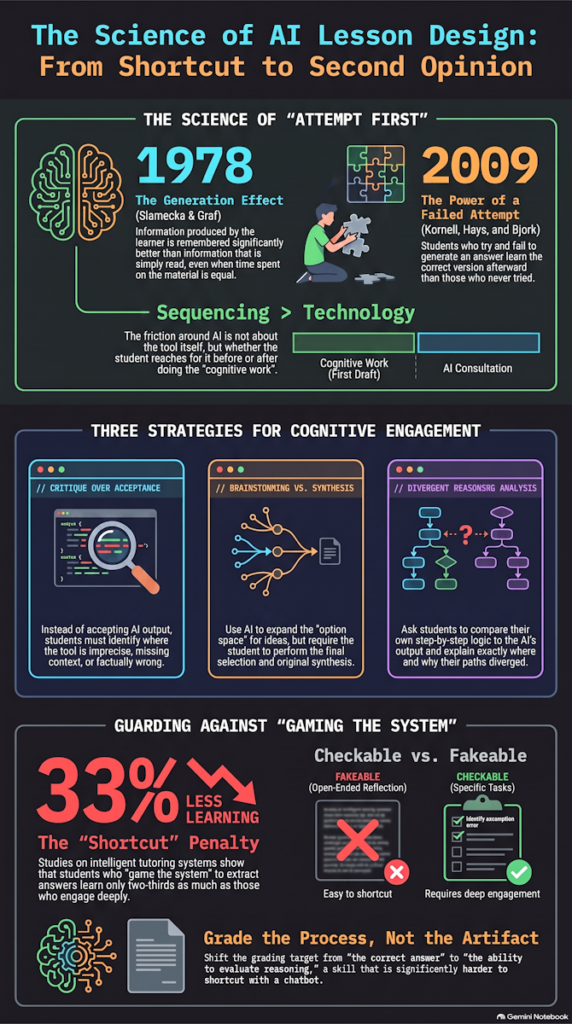
Most of the friction around AI in classrooms isn’t really about the technology — it’s about when in the learning process a student reaches for it. A student who struggles through a first attempt, hits a wall, and only then consults an AI tool to see another approach is doing something fundamentally different from a student who opens the tool first and transcribes the output.
This isn’t just intuition. Slamecka and Graf’s classic 1978 study established the generation effect: information people produce themselves is remembered significantly better than the same information when simply read — even when both groups spend equal time with the material. More strikingly, later work by Kornell, Hays, and Bjork (2009) found that this holds even when the attempt fails — students who unsuccessfully try to retrieve or generate an answer learn the correct answer better afterward than students who never attempted it at all. In other words, requiring a real attempt before the AI tool enters — even a wrong one — is doing measurable cognitive work, not just building character.
A “your attempt first, then the comparison” requirement, built into the assignment structure, does more than an honor-code-style policy about AI use ever will.
A few approaches that put this into practice
- Have students critique an AI-generated answer rather than simply accepting it — find where it’s wrong, imprecise, or missing context.
- Use AI tools for brainstorming, then require original synthesis — the tool expands the option space; the student still has to choose and build.
- Ask students to compare their own reasoning to the tool’s output — not just whether the answers match, but where and why they diverge.
Grading the process, not just the artifact
Assignments that ask students to show where their reasoning diverged from an AI’s — and explain why one approach was better, worse, or just different — shift the grading target from “did you produce a correct answer” to “can you evaluate reasoning, including your own.” That second skill is harder to fake and harder to shortcut with a tool.
A caution worth naming — and the data behind it
None of this works if the critique step becomes its own rote exercise. This isn’t speculation: research on intelligent tutoring systems by Baker, Corbett, and Koedinger found that students who learn to “game the system” — extracting correct answers by exploiting a tool’s hints and feedback patterns rather than engaging with the material — end up learning only about two-thirds as much as students who don’t. Their tutoring systems predate generative AI, but the behavior they documented is exactly the failure mode described here: students quickly learn to perform the appearance of engagement (a generic line about the AI “missing nuance”) without doing real evaluation.
The strongest versions of these assignments ask for something specific and checkable — which step was wrong, what assumption caused it, what a better version would look like — rather than an open-ended reflection paragraph that’s easy to fake.
Why this matters beyond the assignment
The goal isn’t to avoid AI tools, but to design assignments where the tool is a starting point rather than a shortcut. Used this way, AI functions less like an answer key and more like a second opinion a student has to argue with. For educators evaluating how to bring AI into a course, the useful question isn’t “should students be allowed to use it,” but “at what point does this tool enter, and does the assignment still require the student to do the part that mattered.”
What’s still missing is a simple way for a teacher to check, assignment by assignment, whether they’ve actually built in that sequencing — versus assuming a “no AI on the first draft” rule will hold on its own. That’s a gap between the research and the lesson-planning template most teachers are actually working from.
Sources:
- Slamecka, N. J., & Graf, P. (1978). The generation effect: Delineation of a phenomenon. Journal of Experimental Psychology: Human Learning and Memory, 4(6), 592–604.
- Kornell, N., Hays, M. J., & Bjork, R. A. (2009). Unsuccessful retrieval attempts enhance subsequent learning. Journal of Experimental Psychology: Learning, Memory, and Cognition, 35(4), 989–998.
- Baker, R. S., Corbett, A. T., & Koedinger, K. R., et al. Gaming the system in intelligent tutoring systems.