Screen Time and Learning
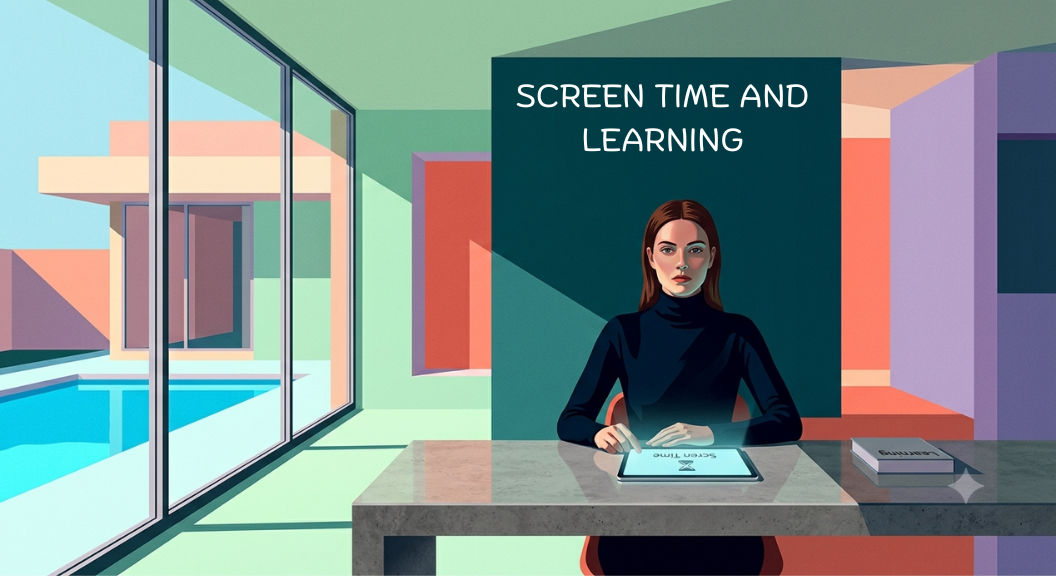
Headlines about screen time tend toward the alarming: more screens, worse outcomes. The actual research doesn’t support that simple a story — and the nuance matters directly for anyone deciding how AI tools get used in a classroom.
The relationship isn’t linear — it’s a curve
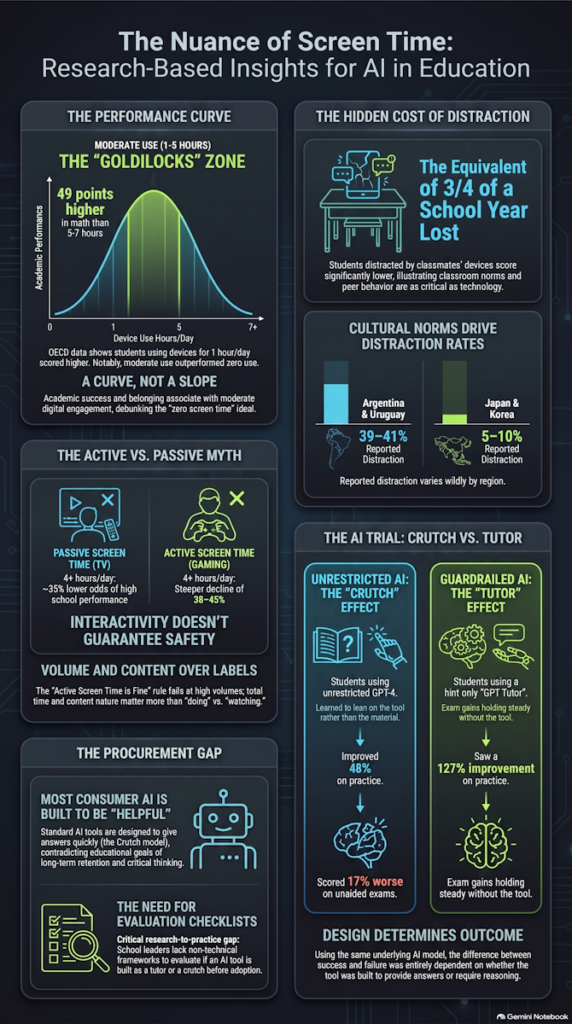
The OECD’s 2023 analysis of PISA 2022 data found that students who used digital devices for leisure up to one hour a day at school scored 49 points higher in math than peers using devices five to seven hours a day. But the same data shows moderate in-school device use for learning (roughly one to five hours) is associated with better academic outcomes and a stronger sense of belonging than not using devices at all. Zero use isn’t the high-performing group; heavy use isn’t either. The pattern is a curve, not a slope.
Distraction compounds this independent of total screen time. Students who report being distracted by classmates’ devices during math class score low enough to lose the equivalent of three-quarters of a school year of learning — with huge variation by country (39–41% of students report this distraction in Argentina and Uruguay, versus 5–10% in Japan and Korea), suggesting classroom norms, not the technology itself, do a lot of the work.
“Active screen time is fine” doesn’t hold up either
It’s tempting to resolve the nuance with a cleaner rule: passive screen time (watching) is the problem, active/interactive screen time (doing) is fine. A 2023 Academic Pediatrics study of 197,439 adolescents across 38 countries (Khan, Gomersall & Stylianou) tested exactly this distinction — and found it doesn’t hold at high volumes. More than four hours a day of TV was associated with 32–39% lower odds of high self-reported school performance. But more than four hours a day of gaming — an “active,” interactive use — was associated with an even steeper decline: 38–45% lower odds. Interactivity alone doesn’t make screen time safe. Volume and content still matter more than the passive/active label suggests.
What this means for AI tools specifically
This is where it gets directly useful for anyone evaluating an AI tutor. A 2024 field experiment by Hamsa Bastani (Wharton) and colleagues, published via PNAS, ran nearly 1,000 Turkish high school students through a controlled trial with three arms: no AI, unrestricted GPT-4 access, and a “guardrailed” GPT-4 tutor built to give hints instead of direct answers.
The results are the clearest data point yet on design, not just usage:
- Students with unrestricted GPT-4 access improved 48% on practice problems — but scored 17% worse than the control group on a later exam taken without AI access. They’d learned to lean on the tool, not the material.
- Students using the hint-only “GPT Tutor” improved 127% on practice problems, and their unaided exam performance was statistically indistinguishable from the control group — the practice gains held without the crutch effect.
Same underlying model, same students, opposite outcomes — determined entirely by whether the tool was built to hand over answers or to require reasoning.
The open problem
Most consumer AI tools students already have on their phones behave like “GPT Base,” not “GPT Tutor” — they’re built to be maximally helpful, which in a homework context means maximally answer-giving. The guardrails that made the difference in Bastani’s study (hints instead of answers, teacher-designed prompting) aren’t something most schools can configure themselves, and most procurement conversations don’t ask about it.
That leaves an open question worth more attention than it currently gets: how should school leaders evaluate whether an AI tool is built like a crutch or built like a tutor before adopting it — and what would a practical, non-technical checklist for that evaluation even look like? That’s a gap between research and practice nobody’s closed yet.
Have you run into this evaluation problem while vetting AI tools for your school or product? We’d like to hear how you’re approaching it.
Sources:
- OECD (2023), Managing Screen Time: How to Protect and Equip Students against Distraction, PISA in Focus
- Khan, A., Gomersall, S., & Stylianou, M. (2023). Associations of Passive and Mentally Active Screen Time With Perceived School Performance of 197,439 Adolescents Across 38 Countries. Academic Pediatrics.
- Bastani, H., Bastani, O., Sungu, A., Ge, H., Kabakcı, Ö., & Mariman, R. (2024). Generative AI without guardrails can harm learning: Evidence from high school mathematics. PNAS.